Meet Alex Kittrell, Sun Valley Heli Ski's new owner who might also be your guide.
He Started by Fueling the Choppers. Now He Owns the Heli-Skiing Op.
https://www.skimag.com/adventure/heli-skiing/sun-valley-heli-ski-owner/

Alex Kittrell started his heli ski career on the ground, literally. He joined Sun Valley Heli Ski 16 years ago as a fuel dispatcher with hopes of one day becoming a guide. Instead, he became the sole owner (and a guide, too). We sat down with Alex Kittrell to find out how fueling helicopters turned into running the oldest heli ski operation in the country (which also boasts the only remote heli ski lodge in the lower 48). The answer is simple: hard work and good people.
SKI: When you first started at the company, did you have your eyes set on buying and owning it one day?
Alex Kittrell: It wasn’t my plan at all. I started at the fuel truck in the very most entry-level position. I started as the fueler or the dispatcher, the person who fuels the aircraft, and keeps track of everybody in the field. I had my eyes set on being a guide, but I wasn’t sure I was gonna stick with it because it was looking like I was never gonna guide, and one day I told my manager, “It looks like the better I do at this job, the less chance I have to be a guide.”
Then I walked in the next day and they said, “Grab your stuff, you’re guiding today.” And I was like, “Okay, here’s my shot.” And then I started guiding. [I became a full-time guide when] the ops manager at the time decided to pursue his other business, and so there was a full-time position for guiding open, and I was the next person in line for it.
I then started guiding for a company in Alaska, as well as Sun Valley Heli Ski. I also started working in management and became the operations manager at Sun Valley Heli Ski. The owner wanted to keep me around, so he gave me stakes in the company to continue as the operations manager. [When he decided to leave] I was gonna sell the company with him, and then the price kept going down, and one day I said, “Well, if you’re gonna sell it for that much, maybe I should buy it.” And he was like, “Well, you know, I want you to buy it.”
And so I leveraged to get ownership of the company.
SKI: You’ve worn many hats at Sun Valley Heli Ski. What’s the most fun?
AK: The most fun is just being a guide. I still guide, but it’s less than it used to be because right now I’m fulfilling other roles in the company. I’m a believer that the owner is where the grease needs to be. I’m the only person in the company who can do every single position, and so I’m wherever the grease needs to be applied. I’ve had less heartache over not guiding than I thought, but the first year was really stressful.
SKI: Sun Valley Heli has been around for 60 years. What’s been the biggest change since the beginning?
AK: The aviation. Our aircraft has improved tremendously. The places that they used to ski, in Sun Valley, in the old days, we don’t… we go way past that now. There’s also noticeable climate change. The average precipitation in Idaho is the same, but we’ve seen that the rain lines come up a little bit, and we’ve seen that we get our snowfall in larger events. So, same amount of snowfall, but instead of getting a few inches twice a week, we have these atmospheric river events, which is a phrase you didn’t really hear 15 years ago.
So we’re going to further out places than we used to go ’cause there’s more snowfall there, and then they couldn’t do that before with the machines they had. They literally couldn’t. They would have flown out there, dropped somebody off, and the aircraft would have had to go back to get fuel, come back, give somebody a bump, and then go back for more fuel, whereas the new machines allow us to operate for longer periods of time without refueling. The forecasting has also come a long way. I should probably give a plug to the avalanche forecasting centers in the United States. Not just the one here at Sawtooth Avalanche Center, which is a spectacular organization. We’re doing an interesting thing here in the Wood River Valley, like in Sun Valley, where the Avalanche Center created a page where all the professionals can share their observations. We have that locally here in our valley. It’s not available across the United States with all operators like it is in Canada, but that’s been a pretty huge thing to be able to log on and see all the other professionals and observations, and even from the public.

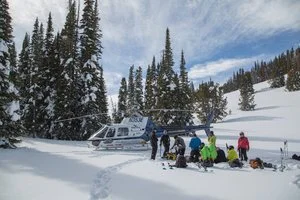
Guests kneel near the rotor wash as a chopper touches down. (Photo: Courtesy of Nick Stelma)
SKI: As an owner, what are some of the biggest strengths and challenges of operating the company out of Sun Valley?
AK: One strength is the accessibility. A lot of folks, when they put these trips together, find time very difficult for them; the logistics are hard, they’ve got kids, they’ve got high-powered jobs, they’ve got other family, they have busy schedules, and the accessibility in the lower 48 is one thing that makes it easier for folks. I have clients who decided to start coming to Sun Valley Heli Ski instead of Alaska because of the travel time. Alaska is very remote, so heli skiing there has a very remote feel, and the mountains are different, but we do have Alaska-esque remoteness here [in Idaho], which is nice.
I think one of the challenges in the industry is trying to reach out to an intermediate skier who makes cautious decisions in the backcountry. That’s somebody who, if they come heli skiing, they’re gonna love it, and they’re probably gonna keep coming back. I love Warren Miller. I’ve guided a segment for Warren Miller, but these Warren Miller-type videos that are so extreme and paint a picture of heli skiing that’s not necessarily accurate for the average client. [Intermediate skiers] really want to go heli skiing, but they don’t think they can, ’cause they see extreme skiers on videos. And the videos are awesome, but they picture that as heli skiing. Getting through that barrier of convincing folks that they have the ability is something that we think about a lot.
SKI: Sun Valley Heli Ski is celebrating 60 years and is the longest permitted heli ski operator in the country. What do you attribute to the success?
AK: Hard work. That’s the easiest one to answer. A lot of my motivation comes from the fact that there have been so many individuals who have just kept this alive for so long. Heli skiing is a difficult industry to be in, and a lot of hard work, from a lot of really talented people over all these years, and the desire to just keep it going.